

The Wine Scholar Database :: Powered by ConcurrentLabs
The Main Navigation Form
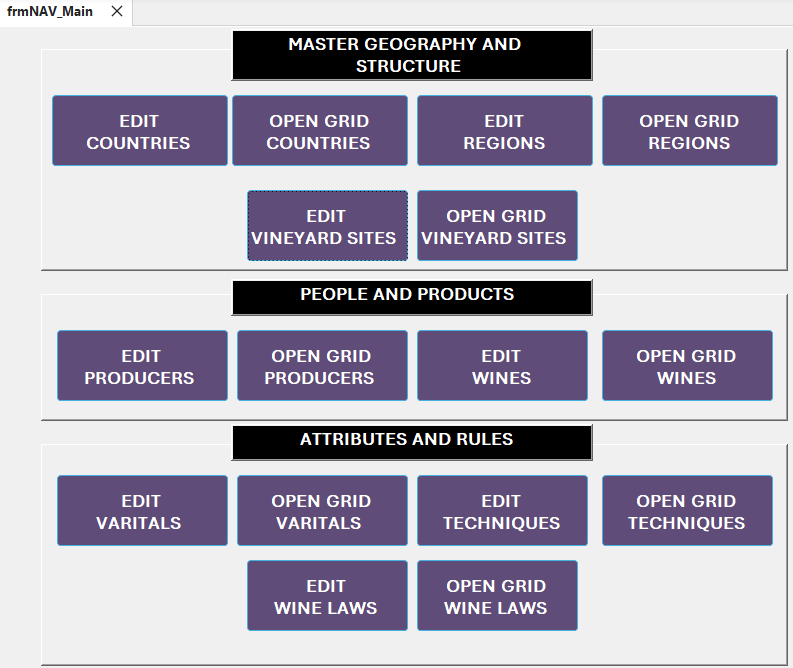
It serves as the database’s command center. From a single screen, users can open, edit, and explore every key area — countries, regions, grapes, producers, and more. It replaces complexity with clarity, using large, color-coded buttons and logical grouping for seamless movement between sections. What could feel like a maze of tables instead becomes an intuitive workspace. Built with scalability in mind, it can easily integrate future modules such as AI-assisted input, flashcard generation, and tasting reports — all accessible from this central hub.
Relational Design
The Backbone of the Wine Scholar Database
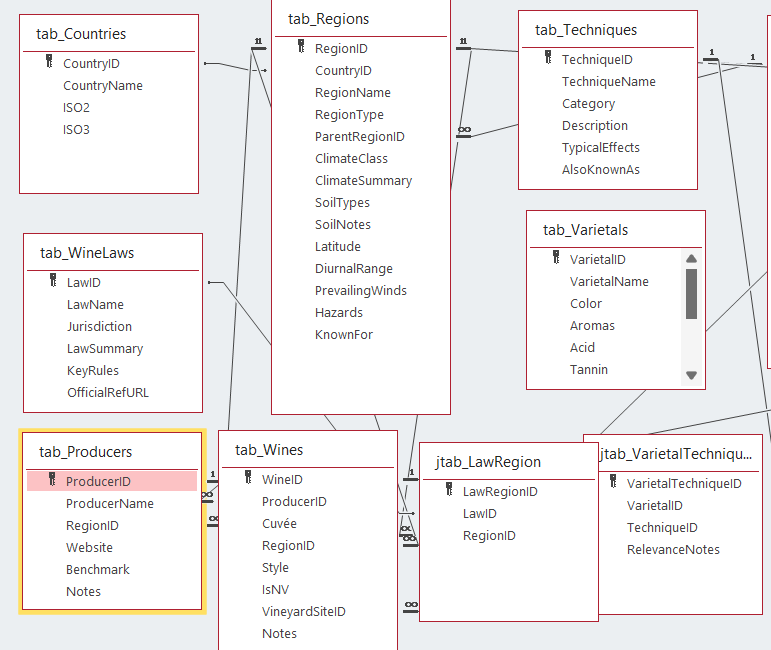
Beneath the surface lies a carefully engineered relational structure that mirrors the way wine actually works in the real world: countries contain regions, which contain producers, which create wines from specific varietals using defined techniques. These relationships maintain data integrity and make exploration natural — change a law, and every related region updates automatically. This interconnected design turns the database into more than just a tool; it’s a living map of the wine world, capable of revealing patterns and hierarchies that traditional notes could never show.
Intelligent Table Design – Guided by AI Insight
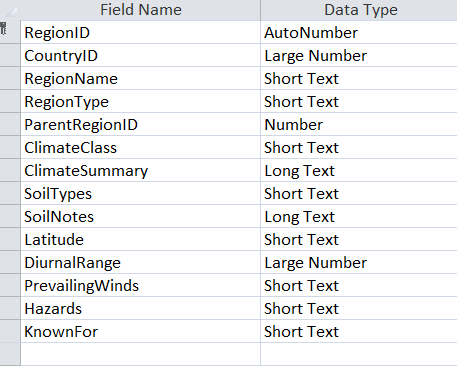
Each table in the Wine Scholar Database is built with AI guidance. During the design phase, AI helped identify essential fields — such as CountryID, RegionName, and ParentRegionID — while also suggesting new, insightful dimensions like climate class, diurnal range, and prevailing winds. These additions open analytical doors that might otherwise remain closed. Over time, this approach builds not just a database, but a knowledge engine that grows with the user’s curiosity and understanding, revealing deeper links between soil, climate, and style.
WSET Tasting Form
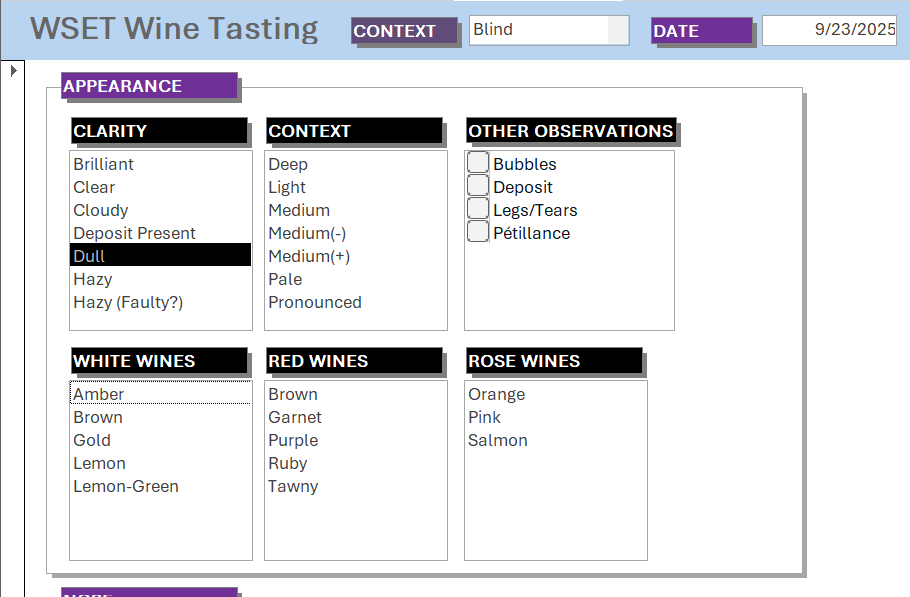
The digital tasting module brings WSET’s structured evaluation system to life. Users can log appearance, aroma, and flavor characteristics in a familiar grid-based layout — complete with contextual notes, color references, and key observations. Each entry becomes part of a personal sensory record, allowing long-term trend tracking and comparison across regions or varietals. With AI assistance, the form can even suggest likely varietal matches or highlight outliers. It’s not just about data entry — it’s about training the palate through organized insight. The tasting form for the CMS is still being worked on.
🔍 Smart Organization
Every region, subregion, classification, and style is interconnected through relational tables, making it effortless to visualize how the wine world fits together. Instead of juggling multiple books or notes, users can browse, search, and cross-reference data instantly.
🤖 AI-Assisted Data Entry
With AI integration, the database automatically populates much of the complex information saving hours of manual work. AI tools help verify appellation hierarchies, typical varietals, and tasting descriptors so the student can focus on learning, not typing.
By blending AI automation with human curation, the system learns as it grows. Over time, it identifies missing attributes, highlights inconsistencies, and recommends related data entries turning static study materials into an evolving, intelligent knowledge base.
🧩 Relational Framework – The Backbone of the System
Behind the user-friendly interface lies a meticulously engineered relational structure, the true heart of the Wine Scholar Database. Each table and connection is designed to mirror how the wine world operates:
Countries connect to regions
Regions connect to subregions and producers
Producers link to wines
Wines connect to grapes, techniques, and classifications
This hierarchical mapping allows data to flow logically and consistently across every form and report. Change a rule or update a grape detail, and the related records update automatically ensuring accuracy and saving time.
The result is more than a data structure; it’s a knowledge model that helps students visualize how geography, varietal, and tradition interlock to form wine identity. This relational depth reinforces learning while laying the groundwork for scalable, enterprise-level database systems.
🧠 Smart Table Design – Guided by AI Insight
Each table was designed through a collaboration between domain expertise and artificial intelligence. During development, AI helped identify the core fields required for relational accuracy (like CountryID, RegionName, and ParentRegionID) while also suggesting additional fields that unlock deeper learning such as DiurnalRange, PrevailingWinds, and KnownFor.
These fields weren’t arbitrary additions; they expand analytical and educational potential. By incorporating environmental and stylistic attributes, the database reveals patterns for example: how diurnal range affects grape acidity or how regional winds shape wine style.
This process demonstrates how AI not only accelerates setup but also enhances human creativity, leading to structures that teach as much as they store.
📊 Structured Reports & Dashboards
Reports and summaries transform raw data into visual insight. Students can filter by country, region, grape, or wine style or run comparative reports like Old World vs. New World acidity trends. These dashboards help students understand relationships and reinforce study retention through pattern recognition.
Each report is generated dynamically, ensuring that as new data is added, insights stay current an invaluable feature for both students and educators.
🧠 Flashcard Module
A built-in flashcard generator turns every record into a learning opportunity. Each time a new grape, region, or law is added, it becomes part of an automatically generated flashcard set. Students can quiz themselves or focus on weak areas, making memorization adaptive and efficient.
🍇 Digital Tasting Form
The WSET-style tasting form brings structure to sensory learning. Students can log appearance, aroma, and flavor descriptors using standardized terminology, improving consistency and recall. Over time, they can analyze results to detect personal patterns such as recurring descriptors or biases and refine tasting accuracy.
💡 Built for Learning. Scalable for Business.
Although originally designed for one wine student, this system scales easily to support wine schools, tasting groups, or distributors. Its modular architecture allows for easy integration of new features such as production tracking, certification test prep, or supplier management.
The Wine Scholar Database represents what ConcurrentLabs does best: building AI-powered systems that turn complexity into clarity, and information into insight combining structure, automation, and elegance into a single, intelligent ecosystem.
🚀 Imagine What We Can Build for You
If this is what we can design for one student tackling one of the hardest courses in the world, imagine what ConcurrentLabs
can do for you.
Whether you’re managing education programs, inventory systems, client data, or business analytics — we can transform your workflow into a tailored AI-driven ecosystem that organizes, automates, and scales with your vision.
From concept to execution, we make data work for you.